
You do not have to wait for a positive pregnancy test to start thinking about pregnancy health.
Preconception counseling is a medical review before pregnancy. It looks at your health, medicines, previous pregnancies, vaccinations, family history and lifestyle to identify anything worth addressing before you conceive. It does not guarantee an uncomplicated pregnancy, but it gives you an opportunity to reduce avoidable risks and enter pregnancy better prepared.
The value of doing this beforehand is simple: some of the most useful changes can be made before conception, not after pregnancy has already begun.
For example, folic acid is recommended before pregnancy because the baby’s brain and spinal cord begin developing very early, often before a woman knows she is pregnant. Some medicines may also need to be reviewed or changed in advance, and conditions such as diabetes, high blood pressure or thyroid disease may benefit from better control before conception.
What Is Preconception Counseling?
Preconception counseling, also called preconception care or pre-pregnancy counseling, is medical care provided before you become pregnant.
It is not simply a fertility check.
The purpose is broader: to understand your current health and identify whether anything should be investigated, treated, adjusted or discussed before pregnancy begins.
According to ACOG, pre pregnancy care aims to optimise health, address modifiable risk factors and provide information that may support maternal and fetal health during a future pregnancy.
During the consultation, your doctor may review:
- your menstrual and reproductive history
- previous pregnancies and any complications
- current medical conditions
- prescription medicines
- over-the-counter medicines
- vitamins, supplements and herbal products
- vaccinations
- family and genetic history
- nutrition and folic acid intake
- smoking, alcohol or other substance use
- exercise and general health
- mental and emotional wellbeing
- whether any screening tests are due
Not every woman needs every test. A good preconception assessment should be based on your history rather than simply ordering a standard package of blood tests for everyone.
Why Is Preconception Counseling Important Before Pregnancy?
A lot happens in the first few weeks of pregnancy. In fact, some important stages of fetal development begin before you may even realise that you have conceived. ACOG notes that the first eight weeks are a particularly important period for the development of major fetal organs.
That is why preparation before pregnancy can matter.
1. It gives you time to review your medicines
Many women take regular medication for conditions such as thyroid disease, high blood pressure, diabetes, epilepsy, acne, anxiety or depression. Some medicines can continue during pregnancy. Others may need to be changed, adjusted or reviewed before conception.
The important point is:
Do not stop prescription medication simply because you are planning a pregnancy.
Stopping an important medicine abruptly can sometimes be more harmful than continuing it. Your doctor can review the risks and benefits and, when necessary, coordinate changes with the doctor who originally prescribed it.
2. It allows medical conditions to be reviewed before pregnancy
Pregnancy changes how the body works. Conditions that are well controlled outside pregnancy may require different monitoring or treatment once you conceive. Preconception care is particularly useful for women with conditions such as:
- diabetes
- high blood pressure
- thyroid disorders
- epilepsy
- significant mental health conditions
- autoimmune or other chronic illnesses
Having one of these conditions does not mean that you cannot have a healthy pregnancy. It means that planning ahead may give your medical team an opportunity to optimise your health before pregnancy places additional demands on your body.
3. It gives you time to check your vaccinations
Some vaccinations are best addressed before pregnancy.
Your doctor can review your vaccination history and identify whether anything is missing. Certain live vaccines, such as the measles, mumps and rubella vaccine, need to be given before pregnancy rather than during it, with an interval before trying to conceive.
This is especially useful if your vaccination history is incomplete or you have received vaccinations in different countries and are unsure what you have already had.
4. You can start folic acid at the right time
Folic acid is one of the most important parts of preconception health.
The CDC recommends 400 micrograms of folic acid daily for women who can become pregnant and advises starting at least one month before conception. Folic acid helps reduce the risk of neural tube defects affecting the developing baby’s brain and spine.
Some women need a higher dose because of their medical or pregnancy history. Your doctor can tell you whether the standard amount is appropriate for you.
5. Previous pregnancy problems can be discussed in advance
If you have previously experienced:
- miscarriage
- ectopic pregnancy
- gestational diabetes
- pre-eclampsia
- preterm birth
- stillbirth
- a baby affected by a genetic or congenital condition
- difficult pregnancy or delivery complications
Reviewing what happened before becoming pregnant again can be helpful. However, this does not necessarily mean the same problem will occur in a future pregnancy. The purpose is to understand whether your history changes how you should prepare or whether additional assessment would be useful.
What Is Discussed During a Preconception Assessment?
There is no single preconception checklist that fits every woman. Your consultation should focus on the parts of your health that actually matter to your pregnancy plans.
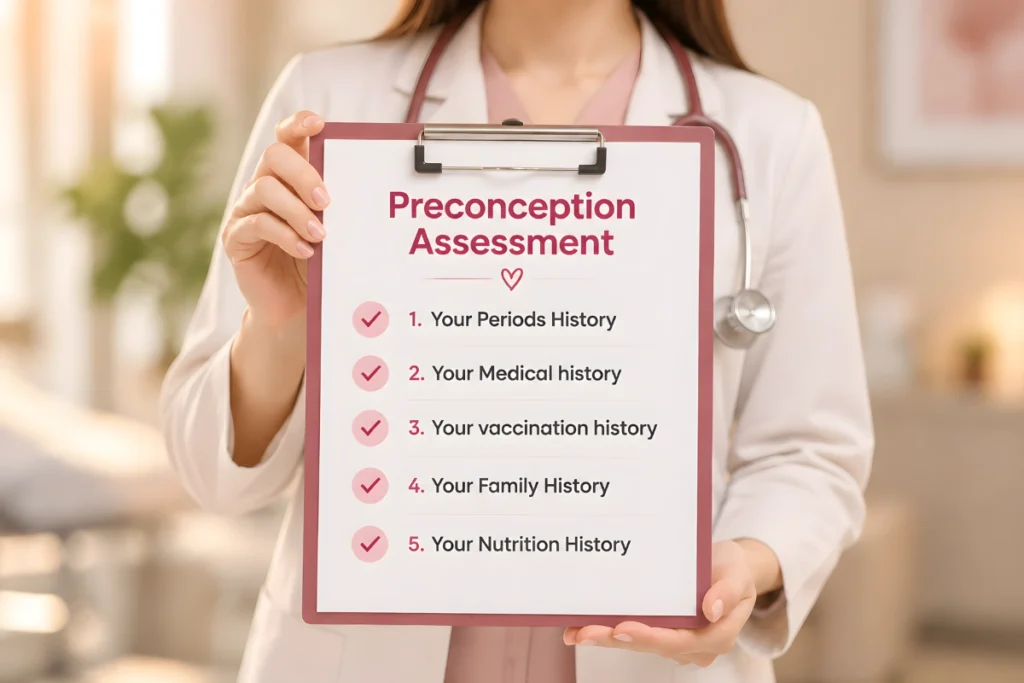
1. Your periods and reproductive history
Your gynecologist may ask:
- Are your periods regular?
- How long are your cycles?
- Have you previously been pregnant?
- Have you experienced miscarriage or ectopic pregnancy?
- Were there complications during previous pregnancies?
- Have you had gynecological surgery?
- Do you have conditions such as PCOS or endometriosis?
- How long have you been trying to conceive, if you have already started?
This information helps your doctor understand whether any further evaluation is needed.
2. Your medical history
Tell your doctor about any ongoing or previous health condition, even if it currently feels well controlled. Conditions such as diabetes, hypertension and thyroid disease can affect pregnancy planning and may need review before conception.
3. Every medicine and supplement you take
This includes more than prescription medication.
Bring or list:
- prescription medicines
- over-the-counter medicines
- vitamins
- herbal preparations
- nutritional supplements
- injections or other regular treatments
Patients sometimes assume that because something is “natural,” it is automatically suitable during pregnancy. That is not always the case. ACOG recommends reviewing both prescription and non prescription medicines, including supplements and herbal products, before pregnancy.
4. Your vaccination history
Your doctor may review whether you are up to date with vaccines relevant to your age and medical history. If you have moved between countries or do not have a complete vaccination record, mention this during the consultation rather than trying to work it out yourself.
5. Family and genetic history
You may be asked whether either you or your partner has a family history of:
- inherited medical conditions
- known genetic disorders
- certain birth defects
- significant developmental disorders
- recurrent pregnancy loss
Depending on your background and family history, carrier screening or genetic counseling may be discussed. ACOG recommends that genetic and family history form part of prepregnancy assessment.
This does not mean every couple needs extensive genetic testing. The decision depends on your individual history.
6. Nutrition and folic acid
Your doctor may discuss whether your diet is meeting your nutritional needs and whether you should start a supplement containing folic acid.
For most women, getting 400 micrograms of folic acid every day before pregnancy is recommended. Do not assume that taking more is necessarily better. Higher-dose folic acid is recommended only in certain circumstances and should be discussed with your doctor.
7. Smoking, alcohol and other substances
If you smoke, vape, drink alcohol or use recreational substances, this is worth discussing before pregnancy.
The purpose of asking is not to judge you. It is to understand anything that may affect pregnancy and to help you make changes before conception when possible. CDC recommends avoiding alcohol, smoking and certain drugs when preparing for pregnancy.
8. Mental and emotional health
Your mental health matters during pregnancy too.
If you have experienced anxiety, depression, an eating disorder, significant stress, previous birth trauma or another mental health condition, mention it. This is particularly important if you take medication, because treatment should be reviewed carefully rather than stopped without medical guidance.
How Can You Prepare for Pregnancy After the Consultation?
Preconception counseling is useful because it turns “I want to have a baby” into a more practical plan. That plan will not look exactly the same for every woman.

1. Start folic acid before conception
Unless your doctor recommends otherwise, taking 400 micrograms of folic acid every day at least one month before conception is recommended to reduce the risk of neural tube defects.
2. Review your medicines rather than stopping them yourself
If a medicine needs changing, it is often better to make that change before pregnancy.
This gives your doctor time to find an appropriate alternative and make sure your underlying condition remains controlled.
3. Get existing medical conditions under the best control possible
If you have diabetes, hypertension, thyroid disease or another chronic health problem, preparation may involve blood tests, medication review or consultation with another specialist.
The aim is not to achieve “perfect health” before pregnancy. It is to deal with issues that can reasonably be improved beforehand.
4. Check whether any vaccinations are due
Some vaccines can be given during pregnancy, while others should be given beforehand. Checking early gives you enough time to complete any vaccinations that require an interval before conception.
5. Focus on sustainable health habits
Preparing for pregnancy does not require a detox, extreme diet or complicated supplement routine.
For most women, the basics matter more:
- eat a varied, balanced diet
- stay physically active in a way that is appropriate for you
- get enough sleep
- avoid smoking
- avoid alcohol while trying to conceive
- discuss any regular supplements with your doctor
If weight is a health concern, the discussion should focus on your overall wellbeing and pregnancy risks rather than simply chasing a number on the scale.
When Should You See a Gynecologist for Preconception Counseling?
You can discuss pregnancy planning whenever you are thinking about trying to conceive. You do not have to wait until you are actively trying.
Ideally, having the conversation before conception gives you enough time to make any useful changes. Folic acid, for example, should ideally be started at least one month before pregnancy. Some vaccinations or medication changes may require more time.

A preconception discussion can be particularly valuable if:
- you take regular prescription medication
- you have a chronic medical condition
- your periods are irregular
- you have PCOS, endometriosis or another gynecological condition
- you have previously had pregnancy complications
- you have had recurrent miscarriages
- you or your partner have a significant family history of genetic disease
- you are unsure whether your vaccinations are up to date
- you have questions about supplements before pregnancy
- you simply want to understand what you should do before trying to conceive
You do not need to have a medical problem to benefit from the conversation.
For someone with no known health concerns, the consultation may simply confirm that there is little that needs changing beyond a few sensible steps.
What to Expect During a Preconception Consultation in Dubai
If you are planning pregnancy in Dubai, a preconception appointment is usually more conversation than investigation. You should not expect every consultation to result in a long list of blood tests.
1. Your doctor will first understand your plans
You may be asked when you hope to start trying for pregnancy, whether you are currently using contraception and whether you have previously been pregnant.
There is no “correct” timeline. The purpose is simply to know where you are starting from.
2. Your medical and pregnancy history will be reviewed
Your gynecologist will ask about health conditions, previous operations, past pregnancies and any previous pregnancy complications.
If you have medical reports from another doctor or another country, bringing them can prevent unnecessary repetition.
3. Your medicines and supplements will be checked
A written list is useful, but bringing the packaging or taking photographs of the labels can make the review easier.
Remember to include supplements and herbal products.
4. Your vaccination and screening history may be reviewed
Depending on your age, history and previous results, your doctor can check whether any routine screening or vaccination needs attention before pregnancy.
5. Tests are ordered only when there is a reason
A pre-pregnancy check-up does not automatically require fertility hormones, ovarian reserve testing, ultrasound or an extensive laboratory panel. Testing should answer a clinical question.
For example, blood tests may be appropriate because of your medical history, symptoms, previous pregnancy complications or a suspected deficiency. Genetic or infection screening may also be relevant for some patients.
Someone with a straightforward history may need far less investigation.
6. You leave with practical next steps
The most useful outcome of the appointment is clarity. You should know:
- whether there is anything medically important to address first
- which medicines or supplements to continue or review
- whether vaccinations or tests are needed
- when to start folic acid
- whether another specialist needs to be involved
- whether you can begin trying for pregnancy or whether there is a reason to wait
That is far more useful than receiving a generic list of “pregnancy preparation” rules from the internet.
Frequently Asked Questions About Preconception Counseling
1. When should I have preconception counseling?
You can have preconception counseling whenever you begin thinking seriously about pregnancy. Having the discussion before you start trying gives you more time to review medicines, vaccinations and medical conditions. Folic acid should ideally be started at least one month before conception.
2. Do I need preconception counseling if I am healthy?
It can still be useful. Even if you have no known medical problems, the consultation can confirm whether your vaccinations are current, review medicines or supplements, discuss folic acid and identify anything in your family or reproductive history that deserves attention before pregnancy.
3. What tests are done before trying to get pregnant?
There is no universal set of tests that every woman needs. Testing depends on your medical history, symptoms, previous pregnancies, vaccinations and family history. Your doctor may recommend selected blood tests, infection screening or genetic testing when clinically appropriate, but extensive fertility testing is not automatically part of routine preconception care.
4. Should I start folic acid before trying to conceive?
Yes. For most women, 400 micrograms of folic acid daily is recommended before pregnancy, ideally beginning at least one month before conception. Some women need a higher dose because of their medical or pregnancy history, so discuss this with your doctor rather than increasing the dose yourself.
5. Should I stop my medication before trying to get pregnant?
Not without speaking to your doctor. Some medicines need to be changed before pregnancy, while others are important to continue. Stopping medication suddenly can sometimes put your own health at risk. Bring a complete list of prescriptions, over-the-counter medicines and supplements to your preconception appointment.
6. Is preconception counseling the same as a fertility check?
No. Preconception counseling focuses on preparing your overall health for pregnancy. Fertility evaluation specifically investigates difficulty becoming pregnant or factors that may affect fertility. Your gynecologist may recommend fertility assessment if your menstrual history, age, symptoms or time spent trying to conceive suggests that it is appropriate.
7. Does my partner need to prepare for pregnancy too?
Pregnancy preparation is not only about the woman’s health. Your partner’s medical and family history, smoking, alcohol or drug use and certain medicines can also be relevant. If there is a family history of genetic disease or concerns about fertility, your doctor may recommend that both partners are involved in further assessment.
When to Consult Dr. Mahsa Aghaei
If pregnancy is something you are considering, you do not need to arrive at the consultation with a perfect diet, a bag full of supplements and every test already completed. That is what the conversation is for.
Dr. Mahsa Aghaei is a gynecologist in Dubai with over 15 years of experience in women’s health. Her approach is centred on one-on-one care and straightforward explanations, so you can understand what actually matters before pregnancy and what does not need unnecessary attention.
A consultation may be particularly helpful if you take regular medication, have a medical or gynecological condition, experienced complications in a previous pregnancy, have questions about folic acid or vaccinations, or simply want a clearer plan before you begin trying.
The aim is not to make pregnancy preparation complicated. It is to identify what matters for your health, deal with what can reasonably be addressed beforehand, and help you move forward with clearer information.
If you are thinking about pregnancy and want to understand what you should consider beforehand, book a consultation with Dr. Mahsa Aghaei for an individual preconception health assessment.
Medical Reviewer
Dr. Mahsa Aghaei
Gynecologist in Dubai with over 15 years of experience in women’s health.
Link Dr. Mahsa Aghaei to the About page.
Medical Disclaimer
This article is intended for general educational information and does not replace individual medical advice. Preconception recommendations, including medicines, supplements, vaccinations and investigations, depend on your medical and reproductive history. Speak with your gynecologist or healthcare professional before making changes to prescribed treatment.