
If your periods are irregular, you have new or persistent facial hair, acne, scalp hair thinning, or you are having difficulty with ovulation, you may wonder whether PCOS could be the reason.
A PCOS diagnosis is not made with one single test. Doctors usually look at your menstrual history, symptoms and signs of higher androgen levels, and, when needed, blood tests or an ultrasound. Other conditions that can cause similar symptoms also need to be considered before PCOS is confirmed.
For adult women, current international guidance generally uses three key diagnostic features: problems with ovulation, clinical or biochemical signs of excess androgens, and polycystic ovarian morphology. Usually, two of these three features are required after other possible causes have been excluded.
PCOS is usually diagnosed through a combination of your menstrual and medical history, assessment for signs of excess androgen hormones, and appropriate testing. Blood tests can help assess hormone levels, while ultrasound or, in selected adults, anti-Müllerian hormone (AMH) may help assess polycystic ovarian morphology. Not every patient needs every test.
If you are being evaluated by a gynecologist in Dubai, bringing information about your menstrual cycles, symptoms, current medicines and previous blood tests or scans can make the consultation more useful.
What Is PCOS?
PCOS stands for polycystic ovary syndrome. It is a hormonal and reproductive condition that can affect ovulation, menstrual cycles and androgen hormone levels.
Despite the name, having ovarian “cysts” is not required for a diagnosis. Some women with PCOS have polycystic-appearing ovaries on ultrasound, while others can meet the diagnostic criteria without needing an ultrasound at all.
Common features can include:
- irregular or infrequent periods
- periods that stop for several months
- difficulty with regular ovulation
- increased facial or body hair
- acne
- scalp hair thinning
- biochemical evidence of higher androgen levels
PCOS can look different from one woman to another. You do not need to have every possible symptom to have the condition.
A note about the name PCOS
In May 2026, the international PCOS guideline network announced Polyendocrine Metabolic Ovarian Syndrome (PMOS) as the updated name for the condition previously known as PCOS. PCOS, however, remains the familiar term used by many patients and in existing medical information, so this article uses “PCOS” for clarity.
How Is PCOS Diagnosed?
In adults, PCOS is generally diagnosed when at least two of three recognised features are present, after other possible causes have been considered and excluded.
These three features are:
- Ovulatory dysfunction
This may show as irregular, infrequent or absent menstrual periods. - Clinical or biochemical hyperandrogenism
Hyperandrogenism means higher androgen activity. It may appear clinically as excess facial or body hair, or it may be detected through hormone testing. - Polycystic ovarian morphology
This describes a particular appearance of the ovaries. In adults, it may be assessed using ultrasound or, in appropriate circumstances, serum AMH according to the current diagnostic algorithm.
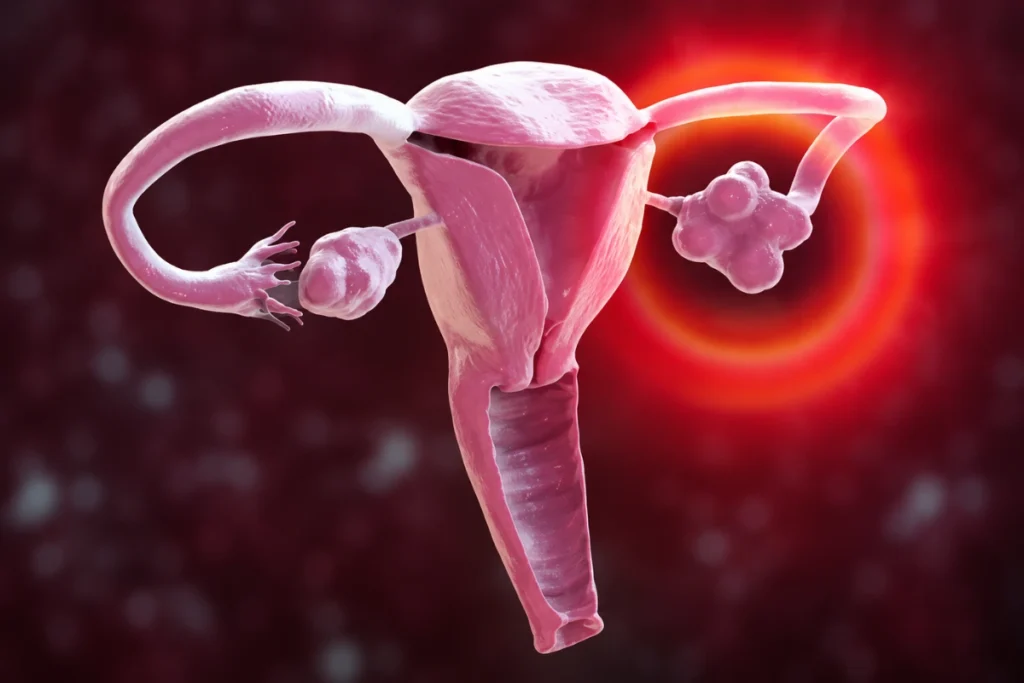
PCOS diagnostic criteria at a glance
| Diagnostic feature | How it may be assessed |
| Ovulatory dysfunction | Menstrual history and cycle pattern |
| Hyperandrogenism | Symptoms, examination and/or androgen blood tests |
| Polycystic ovarian morphology | Ultrasound or, in selected adults, AMH |
An important point is that you may not need all three.
For example, if an adult woman has clearly irregular menstrual cycles and evidence of hyperandrogenism, current international guidance states that an ovarian ultrasound or AMH is not necessary simply to establish the PCOS diagnosis.
This is why ordering an ultrasound or a long list of hormone tests before discussing your symptoms with a doctor may not always give you a clear answer.
What Symptoms and Signs May Lead to a PCOS Evaluation?
Doctors usually begin a PCOS evaluation because of a pattern of symptoms rather than one isolated symptom.
1. Irregular or absent periods
One of the most important clues is an irregular menstrual pattern because PCOS can affect how regularly ovulation occurs.
In adult women more than three years after their first period, current international guidance considers cycles shorter than 21 days, longer than 35 days, or fewer than eight cycles per year as irregular. A cycle lasting more than 90 days more than one year after the first period also warrants assessment.
Not every irregular period means PCOS. Changes in menstrual cycles can have several causes, which is why your overall history matters.

2. Excess facial or body hair
Coarse hair growth in areas such as the face, chest or abdomen can be a clinical sign of excess androgen activity.
Some women remove this hair through threading, waxing, shaving or laser, so the extent may not always be obvious during an examination. Your own description of how your hair growth has changed is therefore useful information.
3. Acne or scalp hair thinning
Persistent acne and female-pattern scalp hair loss can occur alongside androgen excess, although these findings alone are less specific than some other PCOS features. Your doctor will consider them together with your menstrual pattern and other symptoms.
4. Difficulty with ovulation or conception
Because PCOS can interfere with regular ovulation, some women are first investigated after having difficulty conceiving.
However, fertility problems are not required for a PCOS diagnosis.
5. Symptoms that develop very quickly
New, severe or rapidly worsening signs of androgen excess deserve further medical evaluation rather than being assumed to be PCOS. Current guidelines recommend considering other possible causes when androgen levels or symptoms are unusually severe or progress quickly.
What Tests Are Used for PCOS Diagnosis?
Patients often ask, “What is the PCOS test?”
The answer is that there is no single PCOS diagnosis test. Your doctor chooses investigations based on the symptoms and diagnostic features already present.
1. Medical and menstrual history
The first part of PCOS testing may not involve a laboratory at all.
Your gynecologist may ask:
- How old were you when your periods started?
- How long are your menstrual cycles?
- How many periods do you have each year?
- Have your periods always been irregular?
- Have you had several months without a period?
- Have you noticed facial or body hair growth?
- Has your acne changed?
- Have you noticed scalp hair thinning?
- Are you trying to become pregnant?
- What medicines or hormonal contraception are you currently taking?
- Is there a family history of PCOS or related hormonal conditions?
Keeping a menstrual calendar or using a period-tracking app can be helpful because it provides a clearer picture of your cycle pattern.
2. Clinical examination
Depending on your symptoms, your doctor may assess for physical signs associated with androgen excess and other hormonal conditions.
This may include examining:
- facial and body hair growth
- acne
- scalp hair pattern
- other physical findings relevant to your hormonal health
A clinical examination is only one part of the evaluation and does not diagnose PCOS on its own.
3. PCOS blood tests
Blood tests are often useful, but there is no single blood test that confirms or excludes PCOS by itself.
For assessing biochemical hyperandrogenism, the 2023 international guideline recommends measuring total and free testosterone. If these are not elevated but further assessment is needed, other androgen measurements such as androstenedione or DHEAS may sometimes be considered.
The exact tests your doctor requests depend on your history and examination.
Blood testing may also be used to investigate other conditions that can cause irregular periods or similar hormonal symptoms. For example, thyroid function and prolactin may be relevant in women being assessed for menstrual irregularity, depending on the clinical situation.
This is an important part of the diagnostic process because PCOS should not simply be assumed whenever someone has irregular periods.
Can PCOS be diagnosed with a blood test?
Not with one blood test alone.
Blood tests may demonstrate biochemical hyperandrogenism and help rule out other possible causes. However, PCOS diagnosis is based on the complete clinical picture and recognised diagnostic criteria rather than one laboratory value.
If you are taking hormonal contraception, particularly the combined oral contraceptive pill, tell your doctor before hormone testing. It can affect androgen measurements and make some results more difficult to interpret. Do not stop contraception on your own; your doctor can advise whether any change is actually necessary.
4. PCOS ultrasound
An ultrasound can assess the ovaries for polycystic ovarian morphology, meaning a pattern of increased follicles and/or ovarian enlargement that meets recognised criteria.
When ultrasound is required in an adult and is acceptable to the patient, transvaginal ultrasound provides the most accurate assessment of ovarian morphology. A transabdominal ultrasound may be used in other circumstances.
Importantly:
You can have PCOS without needing an ultrasound to diagnose it.
If an adult already has both irregular menstrual cycles and clinical or biochemical hyperandrogenism, the current international diagnostic guideline states that ultrasound is not required to establish the diagnosis.
Similarly, having ovaries that look polycystic on an ultrasound does not automatically mean you have PCOS. The scan must be interpreted together with your symptoms and other diagnostic criteria.
5. AMH testing
Anti-Müllerian hormone, or AMH, is a hormone produced by developing follicles in the ovaries.
Current international guidance allows serum AMH to be used in adults as an alternative method of defining polycystic ovarian morphology within the diagnostic algorithm. However, AMH should not be used as a single standalone PCOS test.
The guideline also recommends using either AMH or ultrasound for this purpose rather than routinely doing both, because unnecessary additional testing may increase the chance of overdiagnosis.
6. Tests for metabolic health
PCOS is associated with metabolic health considerations, so once PCOS is diagnosed or strongly suspected, your doctor may also assess factors such as blood glucose, cholesterol and blood pressure based on your clinical situation.
These tests are important for overall health assessment, but they should not be confused with the criteria used to diagnose PCOS itself.
For example, an insulin test is not required to prove that you have PCOS. Current international guidance notes that routinely available measures of insulin resistance are insufficiently accurate for routine clinical measurement as part of PCOS assessment.
Does everyone with suspected PCOS need an ultrasound?
No.
This is one of the most useful updates for patients to understand.
If you are an adult and already have:
- irregular menstrual cycles and
- clinical or biochemical hyperandrogenism,
an ultrasound or AMH is not required simply to fulfil the diagnostic criteria. Your doctor may still recommend an ultrasound for another clinical reason, but that is different from saying every woman being assessed for PCOS must have one.
Is PCOS diagnosed differently in teenagers?
Yes. Diagnosing PCOS during adolescence requires greater care because irregular periods and changes in hormones can naturally occur during puberty.
Current international guidance requires both ovulatory dysfunction and hyperandrogenism for diagnosis in adolescents. Ultrasound and AMH are not recommended for diagnosing PCOS in adolescents because they do not have sufficient specificity at this stage of life.
The guideline also recognises that menstrual irregularity can be normal during the first year after the first menstrual period. This helps reduce the risk of labelling a teenager with PCOS based only on irregular periods or an ultrasound appearance.

When Should You See a Gynecologist About Possible PCOS?
It may be worth discussing a PCOS evaluation with a gynecologist if you experience:
- persistently irregular periods
- very infrequent periods
- periods that stop for several months
- increasing facial or body hair
- persistent acne alongside menstrual irregularity
- scalp hair thinning
- difficulty with regular ovulation
- difficulty conceiving
- a previous ultrasound report mentioning polycystic ovaries when you are unsure what it means
You should also seek assessment if androgen-related symptoms become severe or progress unusually quickly, as other hormonal causes may need to be excluded.
It is better to evaluate the whole pattern rather than trying to diagnose yourself based on one symptom, one hormone result or one ultrasound report.
What to Expect During a PCOS Evaluation in Dubai
A PCOS evaluation does not necessarily mean arriving at the clinic and immediately having an ultrasound and several blood tests. A thoughtful assessment usually starts with your history.
Step 1: Discuss your menstrual cycles
Your doctor will want to understand how frequently your periods occur and whether this pattern has changed.
If possible, bring a record of your cycles from the past several months.
Step 2: Review your symptoms
You may be asked about:
- acne
- unwanted facial or body hair
- scalp hair thinning
- changes in menstrual cycles
- previous pregnancy or fertility concerns
- medicines and supplements
- hormonal contraception
- relevant family history
Step 3: Clinical assessment
Your doctor may examine signs that are relevant to androgen excess or another possible hormonal condition.
Step 4: Decide which tests are actually needed
This is where an individual assessment matters.
One woman may need blood tests but no ultrasound. Another may need ultrasound because only one of the main diagnostic criteria is clear. Someone else may need additional testing because another hormonal condition needs to be excluded.
Step 5: Review the results together
PCOS should not be diagnosed simply because one number on a blood report is outside the expected range or because an ultrasound mentions multiple follicles.
Your doctor looks at how the history, symptoms, examination and investigations fit together.
Step 6: Discuss what the diagnosis means for you
If PCOS is confirmed, the next conversation depends on what is actually affecting you. For one woman, the main concern may be irregular periods. For another, it may be acne, unwanted hair growth, fertility planning or longer-term metabolic health.
The diagnostic process should therefore lead to an individual plan rather than a one-size-fits-all response.
FAQs About PCOS Diagnosis
How is PCOS diagnosed?
PCOS is usually diagnosed by assessing menstrual cycles, signs or blood-test evidence of excess androgens, and polycystic ovarian morphology when required. In adults, two of these three features are generally needed after other causes have been excluded. Not every woman needs an ultrasound or every available hormone test.
Is there one test that confirms PCOS?
No. There is no single test that confirms PCOS in every patient. Diagnosis is based on a combination of medical history, symptoms, clinical findings and appropriate investigations. Blood tests and ultrasound can contribute to the diagnosis, but neither should automatically be interpreted in isolation.
Can PCOS be diagnosed with a blood test?
A blood test can identify biochemical evidence of raised androgen levels and may help rule out other hormonal conditions, but a blood test alone is not the standard method for diagnosing PCOS. Doctors assess the result alongside menstrual patterns, symptoms and other relevant diagnostic criteria.
Does PCOS require an ultrasound?
No. An ultrasound is not required in every adult being assessed for PCOS. If irregular menstrual cycles and hyperandrogenism are already present, current international guidelines state that ultrasound or AMH is not needed to establish the diagnosis. Ultrasound may still be useful when the diagnostic picture is less clear.
Can an ultrasound alone diagnose PCOS?
No. An ultrasound showing polycystic ovarian morphology does not by itself establish a PCOS diagnosis. The scan needs to be considered alongside menstrual or ovulatory function and evidence of androgen excess, while other possible causes of symptoms are also considered.
What blood tests are commonly used when checking for PCOS?
When biochemical androgen assessment is needed, total and free testosterone are the main recommended tests. Depending on the findings and clinical picture, other androgen tests or investigations for conditions that can cause similar symptoms may also be requested. Your doctor determines which tests are relevant rather than ordering the same panel for every patient.
Can I have PCOS if my ultrasound is normal?
Yes. PCOS can still be diagnosed without polycystic ovarian morphology if an adult meets the other two diagnostic features: ovulatory dysfunction and clinical or biochemical hyperandrogenism, after other possible causes have been excluded. This is why a normal-looking ovarian ultrasound does not automatically rule out PCOS.
Why does my doctor need to rule out other conditions before diagnosing PCOS?
Irregular periods and androgen-related symptoms are not unique to PCOS. Thyroid disorders, prolactin abnormalities and other endocrine conditions can sometimes produce overlapping symptoms. Appropriate evaluation helps ensure that symptoms are not incorrectly attributed to PCOS when another condition requires investigation.
When to Consult Dr. Mahsa Aghaei
If your periods have become irregular, you have symptoms that may suggest higher androgen levels, or you have received blood test or ultrasound results that you do not fully understand, an individual evaluation can help clarify what those findings mean.
Dr. Mahsa Aghaei is a gynecologist in Dubai with over 15 years of experience in women’s health. Her approach focuses on reviewing the complete picture rather than relying on one test result alone, with clear explanations of what each investigation is looking for and whether further testing is actually necessary.
If you have concerns about your menstrual cycles, hormonal symptoms or possible PCOS, you can book a consultation with Dr. Mahsa Aghaei for an individual assessment.
If you have irregular periods or symptoms that may be related to PCOS, book a consultation in Dubai for an individual evaluation.
Medical Reviewer
Dr. Mahsa Aghaei
Gynecologist in Dubai with over 15 years of experience in women’s health.
Medical Disclaimer
This article is for general educational purposes and does not replace individual medical advice, diagnosis or treatment. PCOS symptoms can overlap with other medical conditions, and the tests required vary between patients. Speak with a qualified gynecologist or healthcare professional for an assessment based on your symptoms and medical history.