A short cervix or signs that the cervix is opening earlier than expected can be worrying, especially if you have experienced a late miscarriage or preterm birth in a previous pregnancy.
In some pregnancies, a cervical cerclage may be recommended to help the cervix remain closed for longer. The procedure involves placing a stitch around the cervix and is most commonly considered when there is concern about cervical insufficiency, previous pregnancy history, cervical shortening together with specific risk factors, or painless cervical opening during pregnancy.
But an important point is often missed:
Not every short cervix needs a cervical stitch.
Whether cerclage is appropriate depends on your pregnancy history, cervical length, whether the cervix has started opening, how many babies you are carrying and how far along the pregnancy is.
Cervical cerclage is a procedure in which a stitch is placed around the cervix to help keep it closed during pregnancy. It may be considered for women with cervical insufficiency, certain previous second-trimester losses or preterm births, a short cervix combined with relevant risk factors, or painless cervical dilation during pregnancy. It is usually placed before 24 weeks and a vaginal stitch is generally removed around 36–37 weeks.

What Is Cervical Cerclage?
The cervix is the lower part of the uterus that opens into the vagina. During most of pregnancy, it normally remains long and closed before gradually changing as the body prepares for birth. In some women, the cervix begins to shorten or open much earlier than expected.
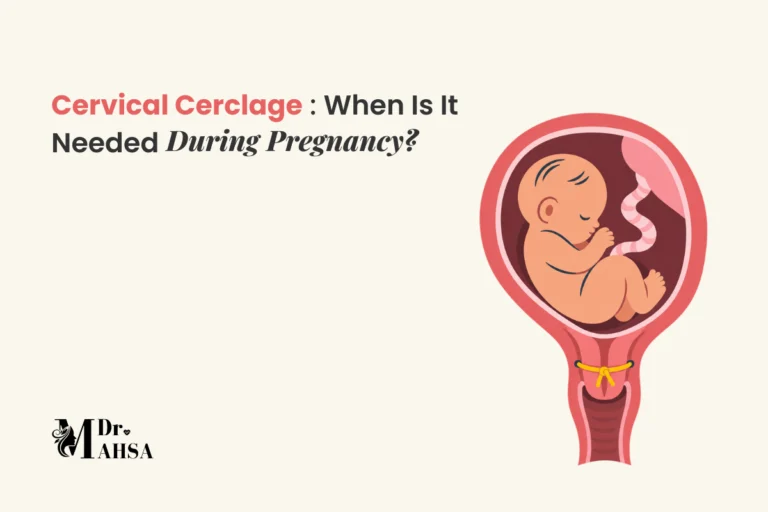
A cervical cerclage, sometimes called a cervical stitch, is a procedure used to provide additional support to the cervix. A strong suture is placed around the cervix and tightened to help it stay closed.
The most common type is a transvaginal cerclage, which is placed through the vagina.
A less common transabdominal cerclage is placed higher around the cervix through abdominal surgery. This may be considered in selected women when a vaginal cerclage has previously failed or cannot be placed effectively.
Cerclage does not guarantee that preterm birth will be prevented. Its role is to reduce risk in women who are considered likely to benefit from the procedure.
When Is Cervical Cerclage Needed During Pregnancy?
There is no single situation in which every woman automatically needs cerclage. Doctors generally consider three clinical scenarios when deciding whether a cervical stitch during pregnancy may be useful.
1. Cerclage based on your pregnancy history
This is sometimes called a history-indicated cerclage. It may be considered when previous pregnancies strongly suggest cervical insufficiency, particularly if there has been a second-trimester pregnancy loss associated with painless cervical opening or a previous cerclage for cervical insufficiency. Your doctor will want to understand exactly what happened during the previous pregnancy.
For example:
- Did labour contractions begin first?
- Did the waters break?
- Was there an infection?
- Or did the cervix open with very little warning or pain?
- Those details matter because not every late miscarriage or preterm birth is caused by cervical insufficiency.
- When a planned cerclage is recommended because of previous history, it is generally placed earlier in pregnancy rather than waiting for the cervix to shorten significantly.
2. Cerclage after a short cervix is found on ultrasound
This is often called an ultrasound-indicated or scan-indicated cerclage. Some women with a history of spontaneous preterm birth or second-trimester loss have their cervical length monitored with transvaginal ultrasound during pregnancy.
If the cervix becomes short, cerclage may be considered depending on the previous pregnancy history and current findings. RCOG patient guidance describes a cervical length below 25 mm as a finding that may lead to discussion of options including cerclage, progesterone or continued monitoring in women already considered at increased risk.
But this does not mean that everyone whose cervix measures under 25 mm should receive a stitch.
For women with a singleton pregnancy who have no previous spontaneous preterm birth, SMFM recommends against cerclage when the cervical length is 10–25 mm if the cervix is not dilated. Vaginal progesterone is recommended for a cervical length of 20 mm or less before 24 weeks and may be considered at 21–25 mm through shared decision-making.
This distinction is important because:
“Short cervix” and “needs cerclage” are not the same diagnosis.
3. Cerclage when the cervix has already started opening
Sometimes cervical dilation is discovered during the second trimester even though the woman has little or no pain and is not in established labour.
In selected situations, an examination-indicated or emergency cerclage may be considered.
Because the cervix has already opened, this procedure carries greater risk and has a lower chance of success than a planned cerclage. The medical team will carefully assess whether the potential benefit outweighs the risks before recommending it.
Cerclage may not be appropriate if there are signs of infection, significant bleeding, contractions or if the waters have already broken.
What Is Cervical Insufficiency and Who May Be at Risk?

Cervical insufficiency describes a situation in which the cervix is unable to remain closed during the second trimester of pregnancy, sometimes resulting in pregnancy loss or very early birth.
Traditionally, this was described as a “weak cervix,” but the reality is more complicated. RCOG notes that cervical strength is likely to exist on a spectrum and may be influenced by several biological and structural factors rather than one simple defect.
A woman may be referred for specialist assessment earlier in pregnancy if she has a history such as:
- a previous miscarriage after 16 weeks
- a previous birth before 34 weeks
- previous early rupture of the waters
- a previous cervical cerclage
- certain procedures involving the cervix, such as a cone biopsy or LLETZ
- particular uterine abnormalities or uterine scarring
- certain previous difficult births or cervical trauma
These factors do not automatically mean that cerclage will be needed. They are reasons to look more closely at your history and, in some cases, monitor the cervix during pregnancy.
Can cervical surgery increase the risk?
Procedures that remove or alter cervical tissue, including some treatments for abnormal cervical cells, may increase the risk of cervical shortening or preterm birth in some women.
The level of risk depends on the procedure and how much cervical tissue was removed.
Having had treatment such as LLETZ does not automatically mean you will need a pregnancy cervical stitch. Your obstetric team may instead recommend cervical-length monitoring first.
Does having twins mean you need cerclage?
Not routinely.
Multiple pregnancies have a higher risk of preterm birth, but routine cerclage simply because a woman is carrying twins is not supported by current evidence.
SMFM recommends against routinely using cerclage to treat cervical shortening in twin pregnancies outside a clinical trial, while RCOG advises that management should be individualised.
How Is Cervical Insufficiency or a Short Cervix Assessed?
There is no single blood test that diagnoses cervical insufficiency. Your doctor usually puts together several pieces of information.
Your previous pregnancy history
This is often one of the most important parts of the assessment.
Your doctor may ask about:
- previous second-trimester miscarriages
- gestational age at previous preterm births
- whether the cervix opened without painful contractions
- whether your waters broke early
- previous cervical procedures
- previous cervical stitches
- previous uterine or cervical surgery
The pattern of events can help distinguish possible cervical insufficiency from other causes of preterm birth.
Transvaginal cervical-length ultrasound
A transvaginal ultrasound can measure the length of the cervix more accurately than abdominal ultrasound when cervical length is being used to guide clinical decisions.
SMFM recommends that measurements used to diagnose or manage a short cervix be performed using a standardised transvaginal technique. For women at increased risk, cervical-length scans may be performed during the second trimester. The result is not interpreted by itself.
A measurement that changes management for one woman may lead to a different recommendation for another because previous pregnancy history matters.
Examination of the cervix
If there is concern that the cervix may already be opening, your doctor may perform an examination. Painless cervical dilation during the second trimester can be one of the findings that leads to consideration of emergency cerclage.
Before proceeding, the team also needs to consider whether there are contractions, bleeding, ruptured membranes or evidence of infection.
What Are the Management Options for a Short Cervix?
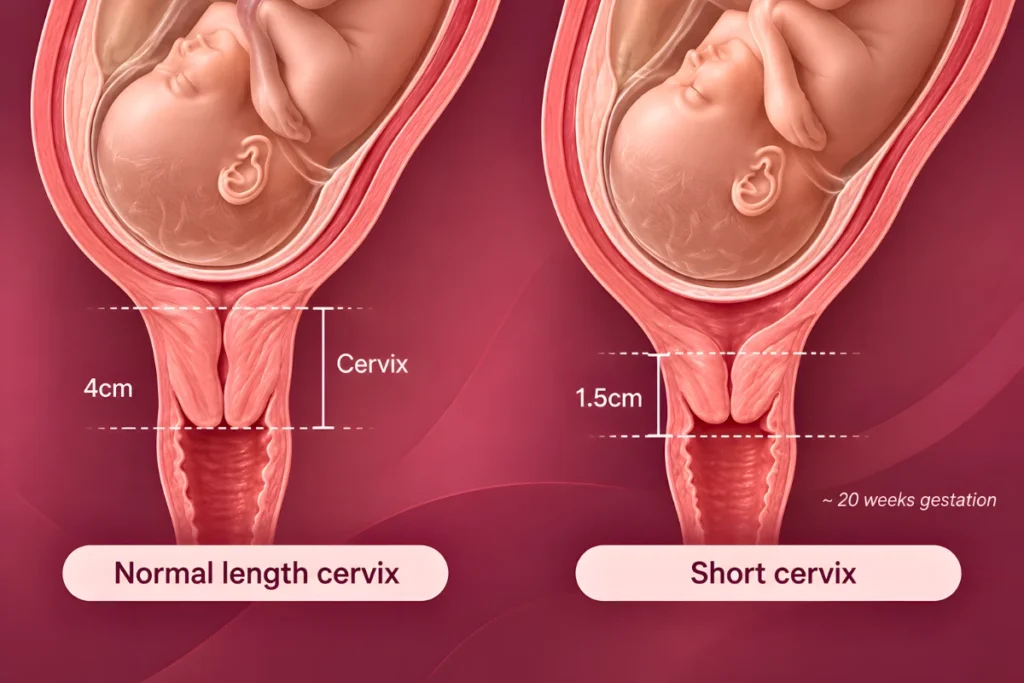
Finding a short cervix does not always lead to surgery. The appropriate approach depends heavily on whether you have had a previous spontaneous preterm birth or second-trimester loss.
1. Cervical-length monitoring
Some women are monitored with repeat transvaginal scans rather than having an immediate procedure.
This allows the obstetric team to see whether the cervical length remains stable or continues to shorten.
2. Vaginal progesterone
For women with a singleton pregnancy, a short cervix and no previous spontaneous preterm birth, vaginal progesterone is an important evidence-based option.
SMFM recommends vaginal progesterone when cervical length is 20 mm or less before 24 weeks. It may also be considered between 21 and 25 mm depending on the circumstances and patient preference.
3. Cervical cerclage
Cerclage is more likely to be considered when pregnancy history suggests cervical insufficiency, when cervical shortening occurs alongside certain previous pregnancy risks, or when the cervix is already beginning to dilate without established labour.
4. Close observation
In some situations, after discussing the benefits and limitations of the available options, continued monitoring may be reasonable.
The important point is that treatment should match the reason the cervix is considered at risk, rather than treating every short measurement in the same way.
When Should You See a Gynecologist About Cervical Cerclage?
It is worth discussing cervical risk early in pregnancy if you have previously experienced a second-trimester miscarriage, very early spontaneous birth, early rupture of membranes, cervical surgery or a cervical stitch in another pregnancy.
You should not wait for symptoms if your previous pregnancy history suggests that cervical monitoring may be useful. This is because cervical shortening can sometimes happen without obvious symptoms.
During pregnancy, contact your maternity team promptly if you develop:
- regular contractions or increasing pelvic cramping
- vaginal bleeding that is persistent or heavy
- fluid leaking from the vagina or concern that your waters have broken
- unusual, foul-smelling or green vaginal discharge
These symptoms are particularly important if you already have a cervical stitch in place. RCOG advises seeking assessment without delay if contractions, significant bleeding, ruptured membranes or abnormal discharge occur after cerclage.
What to Expect Before, During and After a Cervical Cerclage
If your doctor recommends cerclage, understanding what happens can make the procedure feel much less unfamiliar.
Before the procedure
Your obstetric team will review why the cerclage is being recommended and discuss the potential benefits and risks. Depending on the situation, you may have an ultrasound and clinical assessment before surgery.
Cerclage is generally not advised when there are signs of established labour, significant infection, ongoing vaginal bleeding or ruptured membranes, although complex emergency situations require individual specialist assessment.
During the cervical cerclage procedure
Most cerclages are inserted through the vagina. The procedure takes place in an operating theatre. You may have a spinal anaesthetic, which keeps you awake while numbing the lower part of your body, or a general anaesthetic.
A speculum is placed in the vagina so the surgeon can see the cervix. The stitch is then positioned around the cervix and tied securely. The procedure itself generally takes less than an hour.
After the procedure
Some mild cramping, spotting or brown discharge can occur after cerclage. RCOG advises that women usually rest for the first couple of days before gradually returning to normal activities. Routine prolonged bed rest is not recommended.
Your doctor will explain whether there are any individual restrictions relating to exercise, work or sex. You should contact your maternity team urgently if you develop contractions, heavy or persistent bleeding, leaking fluid or unusual vaginal discharge.
When is a cervical stitch removed?
A transvaginal cervical stitch is usually removed at around 36–37 weeks, unless labour starts earlier.
Removal is generally much simpler than insertion. A speculum is used to see the cervix, the stitch is cut and then removed. Anaesthesia is not usually required.
Removing the stitch does not mean labour will necessarily begin immediately.
If labour starts while the stitch is still in place, however, you should contact your maternity team because the stitch normally needs to be removed to avoid injury to the cervix.
What about an abdominal cerclage?
A transabdominal cerclage is different. It is generally reserved for selected women, such as those in whom a vaginal stitch has previously failed or cannot be placed adequately. It may be inserted before pregnancy or early in pregnancy and is usually left in place.
Because the stitch remains around the cervix, delivery is by caesarean birth.
Frequently Asked Questions About Cervical Cerclage
1. Is cervical cerclage needed for every short cervix?
No. A short cervix does not automatically mean you need cerclage. For women with a singleton pregnancy and no previous spontaneous preterm birth, SMFM recommends against cerclage for a cervical length of 10–25 mm when there is no cervical dilation. Progesterone or monitoring may be more appropriate.
2. At what week is cervical cerclage usually done?
A planned cervical stitch is generally placed during the second trimester. RCOG states that cervical cerclage is usually inserted between approximately 12 and 24 weeks, although timing depends on why the stitch is required. Emergency cerclage may be considered later in selected circumstances.
3. What cervical length may lead to consideration of cerclage?
A cervical length below 25 mm is commonly used to define a short cervix during the mid-trimester, but the measurement alone does not decide treatment. Pregnancy history, previous preterm birth, cervical dilation and other factors determine whether cerclage, progesterone or monitoring is more appropriate.
4. Can cervical cerclage prevent all premature births?
No. Cerclage may reduce the risk of late miscarriage or preterm birth in appropriately selected women, but it cannot prevent every premature delivery. Preterm birth can occur for many reasons unrelated to cervical insufficiency, and even a successfully placed stitch cannot guarantee that pregnancy will continue to term.
5. Is cervical cerclage painful?
The stitch is placed under anaesthesia, so you should not feel the procedure in the usual way while it is being performed. Mild cramping, spotting or increased discharge can occur afterwards. Significant pain, contractions, heavy bleeding or leaking fluid should be reported to your maternity team.
6. Do I need bed rest after a cervical stitch?
Routine prolonged bed rest is not usually recommended after cerclage. RCOG advises resting initially after the procedure and then generally returning to normal activities once you have recovered. Your own doctor may give different advice if there are other pregnancy complications or individual concerns.
7. When is a cervical stitch removed?
A vaginal cervical cerclage is generally removed at approximately 36–37 weeks, or sooner if labour begins. Removal is usually a short procedure and often does not require anaesthesia. An abdominal cerclage is different and is generally left in place, with the baby delivered by caesarean birth.
8. Can I have a cervical stitch in my next pregnancy as well?
Possibly. If you required cerclage in one pregnancy, your obstetrician will review what happened before deciding how to manage a future pregnancy. Some women may be offered another planned vaginal stitch, while selected women whose previous vaginal cerclage was unsuccessful may be considered for an abdominal cerclage.
When to Consult Dr. Mahsa Aghaei
If you have been told that your cervix is short, have had a second-trimester pregnancy loss or premature birth in the past, or previously needed a cervical stitch, it is useful to discuss that history early in pregnancy. The most important question is not simply:
“Do I need a cerclage?”
It is:
“What does my pregnancy history and my current cervical assessment tell us about my risk, and which option is most appropriate?”
Dr. Mahsa Aghaei is a gynecologist in Dubai with over 15 years of experience in women’s health. Her approach is centred on one-on-one consultations and clear explanations so that patients understand why monitoring, progesterone, cerclage or another approach may be discussed.
If cervical cerclage is being considered, the consultation should help you understand why it has been recommended, what the alternatives are, what the procedure involves and what follow-up may be needed afterwards.
If you have concerns about cervical shortening, a previous late pregnancy loss or a history of premature birth, discuss your pregnancy history and current findings with Dr. Mahsa Aghaei for an individual assessment.
Medical Reviewer
Dr. Mahsa Aghaei
Gynecologist in Dubai with over 15 years of experience in women’s health.
Medical Disclaimer
This article is intended for general educational information and does not replace individual medical advice. Whether cervical cerclage is appropriate depends on your pregnancy history, cervical findings, gestational age and other clinical factors. Seek urgent maternity assessment if you develop contractions, vaginal bleeding, leaking fluid or unusual vaginal discharge during pregnancy.