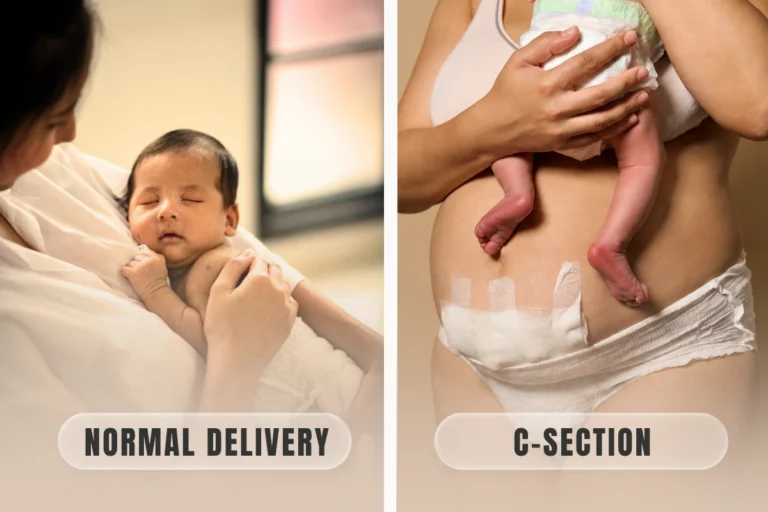
If you are pregnant, you have probably already thought about how your baby will be born. You may be hoping for a vaginal birth, wondering whether you will need a C-section, or simply trying to understand the difference before making a birth plan.
When comparing C-section vs normal delivery, there is no single option that is right for every pregnancy.
A vaginal birth usually means a shorter recovery and avoids abdominal surgery. A C-section may be planned or become necessary when it offers a safer way to deliver the baby. Your medical history, your baby’s position, the placenta, previous births and what happens during labour can all influence the recommendation.
For an uncomplicated pregnancy, vaginal birth is often planned because it avoids major surgery and recovery is usually quicker. A C-section can be the safer option when there are specific concerns involving the mother, baby, placenta or progress of labour. A planned C-section may also be considered after an informed discussion about the woman’s preferences, concerns, benefits and risks.
So rather than asking, “Which type of delivery is better?”, it is often more helpful to ask:
Which option makes the most sense for my pregnancy?
What Is the Difference Between a C-Section and Vaginal Delivery?
The phrase normal delivery is widely used by patients to describe a vaginal birth. Medically, however, vaginal delivery or vaginal birth is more precise because both vaginal and caesarean births are recognised ways of delivering a baby.

What happens during a vaginal birth?
During vaginal birth, contractions help the cervix gradually open so the baby can move through the birth canal and be born through the vagina.
Some vaginal births progress without assistance. Others may require interventions such as induction, pain relief, forceps or ventouse. Occasionally, labour starts with a planned vaginal birth but circumstances change and a C-section becomes necessary.
What happens during a C-section?
A C-section, or caesarean birth, is an operation in which the baby is born through incisions made in the abdomen and uterus.
It may be planned, when the decision is made before labour, or unplanned, when the need for surgery becomes clear during pregnancy or labour.
Most planned caesareans are carried out with regional anaesthesia, usually spinal or epidural anaesthesia. This means you are awake, but the lower part of your body is numb. You should not feel surgical pain, although you may notice pressure or pulling sensations.
C-Section vs Vaginal Delivery at a Glance
| Consideration | Vaginal Birth | C-Section |
| How the baby is born | Through the vagina | Through abdominal and uterine incisions |
| Major abdominal surgery | No | Yes |
| Recovery | Usually quicker after an uncomplicated birth | Usually takes longer |
| Hospital stay | Often shorter | Usually longer |
| Labour | Usually experienced | May be avoided with a planned C-section |
| Perineal tears | Possible | Avoided |
| Assisted birth | Forceps or ventouse may sometimes be needed | Not applicable in the same way |
| Surgical wound | No abdominal wound | Abdominal wound needs time to heal |
| Future pregnancy considerations | No uterine caesarean scar | Previous uterine surgery may influence future birth planning |
Both routes have benefits and potential risks. The balance between them changes depending on the pregnancy.
C-Section or Normal Delivery: Which Is Right for You?
For many women with an uncomplicated pregnancy, planning a vaginal birth is reasonable because it avoids surgery and is usually followed by a quicker recovery.
But there are situations where a C-section is clearly the safer route.
There are also women who are medically able to plan a vaginal birth but are considering a planned caesarean because of previous birth trauma, severe anxiety about labour, concerns about pelvic floor injury or personal preferences.
That conversation deserves more than a simple “yes” or “no”.

Current RCOG guidance recommends discussing why a woman is considering a planned caesarean, explaining the benefits and risks of both options, and addressing concerns such as previous difficult births, pain, vaginal examinations or fear of emergency intervention. If, after an informed discussion, a woman chooses a planned caesarean, that preference should be taken seriously.
This is what shared decision-making should look like.
Your doctor brings the medical information. You bring your health history, previous experiences, concerns and preferences. The birth plan is built around both.
It is also important to remember that a birth plan is not a prediction. You may plan a vaginal birth and later need a C-section. You may discuss a possible C-section earlier in pregnancy and later find that vaginal birth remains a suitable option. Pregnancy and labour can change.
Your plan needs enough flexibility to change with them.
What Factors Can Affect Your Delivery Method?
Several factors can influence whether vaginal birth or caesarean birth is recommended. Doctors rarely make this decision based on one detail alone.
1. Your baby’s position
Towards the end of pregnancy, most babies settle into a head-down position.
If the baby remains breech, meaning the bottom or feet are positioned to come first, your obstetric team will discuss the available birth options. The recommendation can depend on the type of breech presentation, the pregnancy and the experience and facilities available within the maternity unit.
A breech baby does not mean every woman will automatically have the same birth plan.
2. The position of the placenta
If the placenta lies very low and covers the cervix, known as placenta praevia, vaginal birth may not be safe because the placenta blocks the baby’s route through the cervix.
A planned C-section may therefore be recommended.
3. Your baby’s wellbeing
Your baby’s growth and wellbeing are monitored throughout pregnancy. During labour, the baby’s heart rate may also be monitored when clinically indicated.
If there are signs that the baby may not be coping well with labour, your obstetric team may recommend speeding up the birth. Depending on how far labour has progressed, this could mean an assisted vaginal birth or an urgent C-section.
4. How labour is progressing
Sometimes contractions begin normally, but labour does not progress as expected.
The cervix may stop dilating, the baby may not descend as expected, or concerns may arise about continuing labour.
An unplanned C-section may then be recommended.
5. Placental or pregnancy complications
Conditions such as placenta praevia and some cases of severe pre-eclampsia can influence when and how a baby should be born.
The presence of a pregnancy complication does not automatically mean a C-section is required. The severity of the condition, gestational age, baby’s wellbeing and other clinical findings all matter.
6. Significant bleeding
Heavy bleeding during pregnancy or labour requires urgent medical assessment.
Depending on the cause, severity and condition of the mother and baby, rapid delivery may sometimes be necessary.
7. Previous C-section or uterine surgery
One previous C-section does not automatically mean the next birth must also be a C-section.
Many women with one previous lower-segment caesarean may be candidates for vaginal birth after caesarean, or VBAC. RCOG states that around three in four women with one previous caesarean, a straightforward pregnancy and spontaneous labour give birth vaginally.
Whether VBAC is appropriate depends on factors such as:
- the type of previous uterine scar
- why the previous C-section was needed
- whether you have previously given birth vaginally
- the number of previous C-sections
- whether there are complications in the current pregnancy
This discussion should happen during pregnancy rather than waiting until labour starts.
8. Your previous birth experience
Medical history is not the only history that matters.
If you had a traumatic or difficult previous birth, you may understandably approach your next delivery differently.
Perhaps you are worried about another assisted delivery. Perhaps labour pain or vaginal examinations caused significant distress. Or perhaps an unexpected emergency C-section left you feeling that you had little control over what was happening.
These concerns are valid parts of birth planning and should be discussed openly with your doctor.
C-Section vs Normal Delivery: Benefits, Risks and Recovery
Comparing normal delivery vs C-section means looking beyond the actual birth.
Recovery, possible complications, future pregnancies and your individual priorities can all be part of the discussion.
What are the advantages of vaginal birth?
When vaginal birth is uncomplicated, recovery is usually quicker.
Women can often move around sooner, generally have a shorter hospital stay and return to day-to-day activities earlier than after abdominal surgery.
Vaginal birth also avoids risks that are specific to surgery, such as complications involving an abdominal wound or internal scar tissue.
What are the possible disadvantages of vaginal birth?
Vaginal birth is not risk-free.
Some women experience perineal tears or require stitches. An assisted birth using forceps or ventouse may be needed, particularly during a first birth. Pelvic floor symptoms can also occur.
And sometimes a labour that was expected to end vaginally needs to change to an emergency C-section.
What are the advantages of a planned C-section?
A planned C-section avoids labour and vaginal or perineal tearing.
It also reduces the possibility of needing an assisted vaginal birth or an emergency C-section during labour. Some women also value having a planned birth date and greater predictability around the delivery.
When there is a clear medical reason for caesarean birth, its biggest advantage is more fundamental: it may provide a safer route of birth for the mother, baby or both. WHO recognises that medically indicated caesarean birth can prevent maternal and newborn complications and deaths.
What are the possible risks of a C-section?
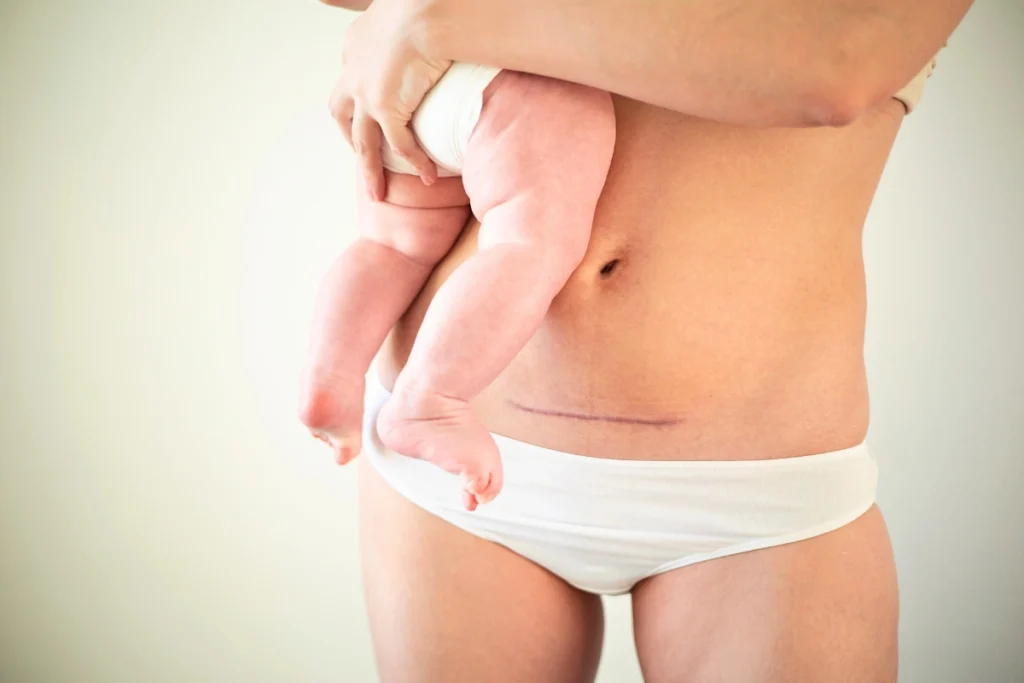
A C-section is major abdominal surgery.
Possible complications include wound or uterine infection, bleeding, internal scar tissue and, more rarely, injury to surrounding organs. Recovery usually takes longer than after an uncomplicated vaginal birth.
A previous C-section also matters when planning future pregnancies. With repeated caesarean births, surgical scar tissue increases and the risk of certain placental complications, including placenta accreta, also rises.
This does not mean women should be frightened of having a C-section when it is needed.
It means the benefits and risks should be understood rather than assuming surgery is automatically easier or automatically more dangerous.
C-Section recovery vs normal delivery recovery
After an uncomplicated vaginal birth, you may be able to move around and return to everyday activities relatively quickly.
That does not mean there is no recovery. Vaginal bleeding, uterine cramping, perineal soreness and discomfort from stitches can all occur.
After a C-section, there is an abdominal wound as well as a healing uterus. Getting out of bed, standing upright, coughing, laughing or lifting can initially feel uncomfortable.
Recovery commonly takes several weeks, but there is no exact timetable that applies to every woman. RCOG describes around six weeks as a usual physical recovery period after planned caesarean birth, while also emphasising that recovery varies.
And there is an important point that simple comparisons often miss:
A straightforward vaginal birth and a complicated vaginal birth are not the same recovery experience. Neither are a planned C-section and an emergency C-section.
How the birth actually unfolds matters just as much as the label attached to it.
When Should You See a Gynecologist About Your Delivery Options?
Birth planning does not need to wait until the final weeks of pregnancy.
You can start asking questions earlier, then revisit the conversation as your pregnancy progresses and more information becomes available.
It is particularly useful to discuss your birth options if you have had a previous C-section or uterine surgery, your baby is breech, your placenta is low, you are carrying twins or multiples, you have developed a pregnancy complication, or you had a difficult previous birth.
You should also bring it up if you feel strongly about a particular way of giving birth.
You do not need to hide fears about labour or apologise for asking about a planned C-section. Equally, if you have been advised to consider surgery but hope for vaginal birth, it is reasonable to ask why surgery is being recommended and whether alternatives exist.
A useful consultation should leave you understanding three things:
- What are my realistic options?
- What are the main benefits and risks of each option for me?
- What circumstances might make the plan change?
These questions reflect the shared decision-making approach encouraged by RCOG.
If you are receiving pregnancy care in Dubai, it is also helpful to understand the maternity hospital where you plan to deliver, including how the team manages emergency obstetric situations and what support is available during labour.
What to Expect When Planning Your Delivery
You do not usually need to decide everything in one appointment.
Birth planning develops throughout pregnancy.
1. Your doctor will first look at your pregnancy
Your gynecologist will review relevant factors such as your health, previous pregnancies, previous operations, baby’s growth and position, placenta, scans and any pregnancy complications.
What matters at 20 weeks may not be the same as what matters at 36 weeks.
2. Your preferences should be part of the conversation
Your doctor should know what matters to you.
If you strongly hope for a vaginal birth, say so.
If the idea of labour makes you very anxious, say that too.
If a previous birth has changed how you feel about this one, explain what happened.
Good birth planning is not about telling a woman what she “should want”. It is about understanding what is medically reasonable, explaining the trade-offs and making decisions with her rather than for her.
3. You should understand what could change the plan
If you are planning vaginal birth, ask what situations could make an assisted birth or C-section necessary.
If you are planning a caesarean, ask what happens if labour begins before the scheduled date.
Knowing the possibilities does not mean expecting something to go wrong. It means you are less likely to hear important information for the first time when you are already in labour.
4. What can you expect during a planned C-section?
Most planned C-sections are performed under spinal or epidural anaesthesia, so you are usually awake while your lower body is numb.
You may notice pressure or pulling during the operation but should not feel surgical pain. Afterwards, your maternity team will monitor you and guide you through pain relief, wound care, movement and recovery.
When there is no medical reason to deliver earlier, planned caesarean birth is generally scheduled at or after 39 weeks because earlier planned caesarean birth is associated with a greater chance of the baby needing support for breathing difficulties.
5. What can you expect when planning a vaginal birth?
Labour may begin with contractions, the waters breaking, or it may sometimes be induced for a medical reason. Throughout labour, your progress and your baby’s wellbeing are assessed. Pain-relief options can be discussed, and intervention is recommended only if circumstances call for it.
A vaginal birth can remain straightforward from beginning to end. It can also evolve. That uncertainty is one reason discussing different possibilities before labour can be so helpful.

FAQs About C-Section vs Normal Delivery
Is normal delivery better than C-section?
Not automatically. Vaginal birth usually avoids abdominal surgery and is associated with a quicker recovery when uncomplicated. A C-section may be safer when there is a medical reason for surgery and may also be chosen after an informed discussion of benefits and risks. The right comparison depends on your pregnancy, not on one method being universally better.
Which recovery is faster, C-section or vaginal delivery?
Recovery is usually faster after an uncomplicated vaginal birth. A C-section involves abdominal and uterine surgery, so soreness and limitations with movement can continue for several weeks. However, a difficult vaginal birth can also involve significant recovery, so the actual birth experience matters as well as the delivery method.
When is a C-section recommended?
A C-section may be advised when vaginal birth could create additional risk for the mother or baby. Examples include placenta praevia, certain breech presentations, concerns about fetal wellbeing, some pregnancy complications, significant bleeding or labour that is not progressing. The exact recommendation depends on the full clinical picture.
Can I have a vaginal birth after one C-section?
Often, yes. VBAC may be suitable for many women after one previous lower-segment C-section. Factors such as the type of uterine scar, reason for the previous surgery, previous vaginal births and current pregnancy all influence the decision. RCOG reports that around three in four suitable women who labour naturally after one C-section achieve a vaginal birth.
Can I request a planned C-section if there is no medical reason?
You can discuss this with your obstetric team. Your doctor should explore why you are considering surgery and explain the benefits, risks and alternatives. RCOG guidance states that after an informed discussion, a woman’s decision to choose a planned caesarean should be supported.
Can a planned vaginal birth become a C-section?
Yes. An unplanned C-section may become necessary if labour does not progress, the baby shows signs of not coping well with labour, significant bleeding occurs or another complication develops. A change in plan does not mean your original birth plan was wrong. It means new information has changed what is safest.
Is a C-section more painful than vaginal birth?
They involve pain at different stages. Labour pain occurs during vaginal birth, while perineal soreness may continue afterwards. Anaesthesia prevents surgical pain during a C-section, but the abdominal wound can be painful while it heals. How much discomfort a woman experiences varies considerably between births.
Does one C-section mean I will always need C-sections?
No. Many women can consider VBAC after one previous C-section. Others may be advised to have a repeat caesarean because of the type of previous uterine incision, pregnancy complications or other clinical factors. Your previous operation and current pregnancy should be reviewed before deciding.
When to Consult Dr. Mahsa Aghaei
If you are pregnant and unsure about C-section vs normal delivery, you do not need to decide based on stories from friends, family or social media.
Your pregnancy has its own history.
Dr. Mahsa Aghaei is a gynecologist in Dubai with over 15 years of experience in women’s health. Her approach is centred on one-on-one care, clear explanations and giving women the space to ask questions about their pregnancy and birth options without feeling rushed or pressured.
During your consultation, you can discuss your medical history, previous deliveries, current pregnancy, concerns about labour and the factors that may affect how your baby is born.
The aim is not to push you towards one type of birth.
It is to help you understand your options and the reasoning behind them.
If you have questions about your pregnancy or how your birth may be planned, book a consultation with Dr. Mahsa Aghaei for an individual assessment.
Medical Reviewer
Dr. Mahsa Aghaei
Gynecologist in Dubai with over 15 years of experience in women’s health.
Medical Disclaimer
This article is intended for general educational information and does not replace individual medical advice. Pregnancy and birth recommendations depend on your health, medical history, pregnancy and baby’s wellbeing. Discuss your individual birth options with your gynecologist or obstetrician.